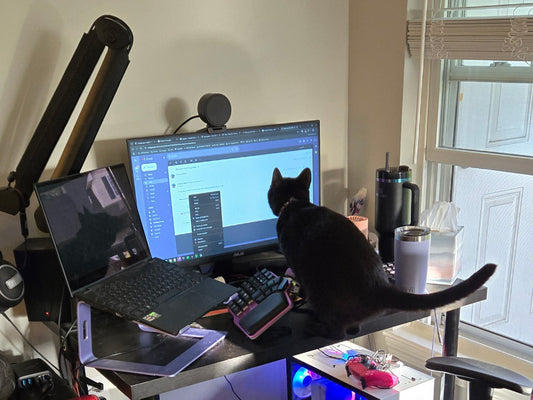
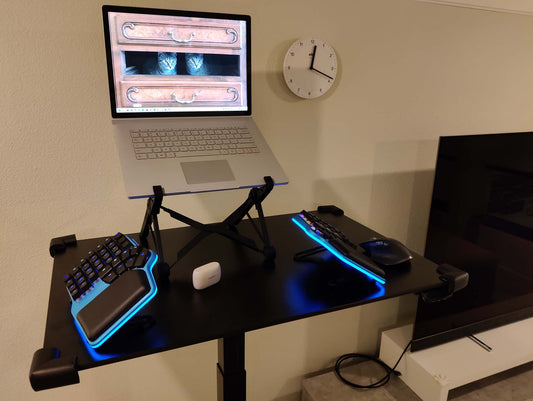
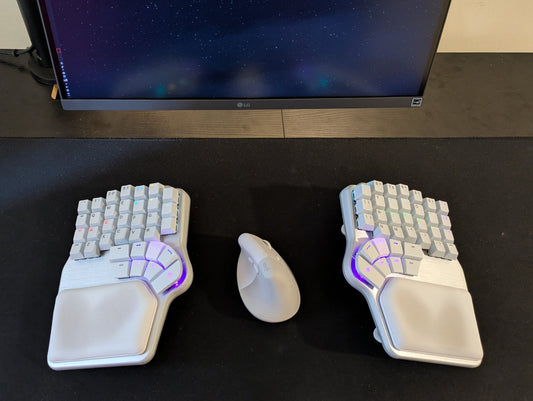
These are all low-profile keycaps. And so are these.
They come in a wide range of shapes, sizes, heights, materials, and profiles. Some are barely 3.5 mm tall, while others are more than twice that height.
But there’s a catch: two low-profile keycaps can look almost identical and still not fit the same keyboard.
After testing more than a dozen different low-profile keycap profiles, Miquel compared their compatibility, shape, height, materials, and typing surfaces to understand what actually matters when choosing a set.
Low-profile keycap compatibility: stems
The most important thing to check before buying low-profile keycaps is compatibility.
Low-profile keycaps mainly use two different stem systems:
- Choc stems, which have two small prongs.

- MX-style stems, which use the familiar cross-shaped mount.

Choc-stem keycaps are compatible with Choc V1-style switches.

MX-style keycaps, meanwhile, work with Gateron low-profile switches and Kailh Choc V2 switches.

That last point can be confusing: despite the name, Choc V2 switches are not compatible with Choc-stem keycaps. They use an MX-style stem instead.
MX spacing, Choc spacing and sub-Choc spacing
The stem isn't the only compatibility issue. You also need to consider switch spacing: the distance between each switch on the keyboard.

The two most common layouts are MX spacing and Choc spacing.

MX spacing uses a 19.05 × 19.05 mm grid, while Choc spacing uses an approximately 18 × 17 mm grid.

There’s also an even more compact option known as sub-Choc or mini-Choc spacing, which uses a 17 × 17 mm grid.

This means that larger keycaps, such as 18.5 × 18.5 mm models, will generally only work on MX-spaced keyboards. Smaller keycaps around 16.5 × 16.5 mm can fit more compact layouts and may also work on MX spacing, but they will leave larger visible gaps between keys.
To make things even more confusing, some keyboards combine Choc V1 switches with MX spacing, while others use MX-stem switches with Choc spacing.

That’s why stem compatibility and spacing compatibility should always be checked separately.
Uniform vs sculpted low-profile keycaps
Another important difference is the profile's shape and height.
Most low-profile keycaps use a uniform profile, meaning every row has the same height and shape. This gives users the freedom to move keycaps around the keyboard without worrying about which row they belong to.

Other designs use a sculpted profile, where each row has a different height or angle. This can help guide the fingers toward different rows and create a more contoured typing surface.

The top surface of the keycap can also vary significantly. Common designs include:
- Flat

- Cylindrical: as if we pressed the keycap with a tube.

- Spherical: as if we pressed the keycap with a ball.

- Hybrid surfaces that combine a cylindrical shape with a central spherical scoop.

Height is particularly relevant for ergonomic keyboards, because lower keycaps can contribute to a thinner overall keyboard and help maintain a more neutral wrist angle.

Choc V1 low-profile keycaps
Some of the smallest low-profile keycaps are designed specifically for Choc V1 switches and compact Choc spacing. These are particularly common on DIY split ergonomic keyboards.
MBK

MBK is one of the most popular Choc low-profile profiles. It combines a very low height with a comfortable spherical typing surface.
It measures approximately 17.5 × 16.5 mm, uses a uniform profile, and is around 4 mm tall.
CFX

CFX is another compact option, especially interesting for keyboards with sub-Choc spacing.
It measures around 16.5 × 16.5 mm, uses a uniform spherical profile, and is only about 3.7 mm tall.
MCC

MCC offers a more cylindrical alternative to the MBK profile.
It measures approximately 17.5 × 16.5 mm, is uniform in cylindrical shape, and has a height of approximately 4 mm.
Compact MX-stem keycaps
But what if you want compact Choc-style spacing with Kailh Choc V2 or Gateron low-profile switches?
There are several compact MX-stem options, particularly from Tai-Hao.
MT165

MT165 keycaps are designed for an extremely compact, minimal setup. They measure approximately 16.5 × 16.5 mm and support sub-Choc spacing.
They have a uniform flat profile and are just 3.5 mm tall. That very flat surface can look extremely clean, although it may provide less tactile guidance when moving around the keyboard.
THCS

THCS is similar to the MT165 but designed around Choc spacing.
It measures approximately 17.5 × 16.5 mm, supports both Choc and MX stems, has a uniform flat profile, and is around 4 mm tall.
THM

THM is a good option for users who want something closer to the MBK experience while using MX-stem switches with Choc spacing.
It measures approximately 17.5 × 16.5 mm, uses a uniform cylindrical profile, and is around 3.94 mm tall.
MX-spacing low-profile keycaps
Many low-profile keyboards use MX spacing, including ergonomic models such as the Voyager, some Corne configurations, and the Dygma Sonsei.
The additional space gives keycap designers more room to experiment with different typing surfaces.
THT

Tai-Hao Thins (THT) are a useful option for users seeking an alternative to MBK, designed for MX spacing.
They measure around 18.1 × 18.1 mm, are available for Choc and MX stems, use a uniform cylindrical profile, and are approximately 3.94 mm tall.
LPF

LPF is a slightly taller alternative to THT.
It measures approximately 18.3 × 18.3 mm, uses an MX stem and MX spacing, has a uniform cylindrical profile, and reaches approximately 4.6 mm.
PFF

PFF introduces a small spherical scoop into an otherwise cylindrical typing surface.
It measures around 18.3 × 18.3 mm, uses MX spacing, has a uniform hybrid profile, and is approximately 5 mm tall.
SMOLO

SMOLO offers a large typing surface with a comfortable spherical scoop. It's also the profile used on the Dygma Sonsei.
The keycaps measure approximately 18.4 × 18.4 mm, use an MX stem with MX spacing, have a uniform spherical profile, and are around 5.3 mm tall.
This combination provides a comfortable typing surface without making the keyboard unnecessarily tall.
NuPhy NSA

NuPhy's nSA profile follows a design very similar to SMOLO.
It measures around 18.2 × 18.2 mm, uses MX stems and MX spacing, and has a uniform spherical profile approximately 4.8 mm tall.
Lofree low-profile

Lofree also uses a similar spherical low-profile design.
Its keycaps use MX stems and MX spacing, have a uniform spherical surface, and measure approximately 5 mm in height.
Skyline

Skyline is another profile similar to SMOLO, although it has a somewhat smaller typing surface.
It measures around 18 × 18 mm, uses MX stems and spacing, has a uniform spherical profile, and is approximately 5 mm tall.
Horizon V2

Horizon V2 follow a similar concept but reduce the typing surface even further.
They measure approximately 18 × 18 mm, use MX stems and spacing, have uniform spherical profiles, and are around 4.5 mm tall.
Keychron LSA

Keychron's LSA profile takes a different approach: every row is slightly angled forward, similar to using the third row of a sculpted profile across the entire keyboard.
This can feel unusual when reaching for the upper rows.
The profile uses MX stems and MX spacing, has an angled spherical surface, and measures approximately 4.3 mm in height.
Mahjong

The Mahjong profile is an interesting option for users who want the visual appearance of a flatter keyboard combined with spherical indentations.
It measures approximately 18 × 18 mm, uses MX stems and spacing, has a uniform spherical profile, and is around 5 mm tall.
Medium-profile keycaps
Some keycaps push the boundaries of what can reasonably be called low-profile, but they can offer interesting ergonomic advantages.
Lamé

Lamé is particularly interesting if you want to recreate something closer to a concave keywell on a flat keyboard.
It uses a sculpted saddle-shaped profile and supports Choc and MX stems with Choc spacing.
Depending on the version and position, heights range from roughly 4.2–4.3 mm at the saddle to around 7.8–8.1 mm on tilted sections.
PBS

PBS is a slightly lower alternative to the traditional DSA profile and uses a larger spherical scoop.
It measures approximately 18.5 × 18.5 mm, uses MX stems and MX spacing, has a uniform cylindrical profile with a spherical scoop, and is around 7.5 mm tall.
LAK

LAK is primarily an aesthetic choice. Its typing surface is smaller than that of many alternatives, while the overall keycap height is taller.
It measures around 18 × 18 mm, uses MX stems and spacing, has a uniform profile with a slightly cylindrical bump, and is approximately 6.5 mm tall.
Berry

Berry is particularly interesting for users looking for something similar to the famous Cherry sculpted profile but adapted to a low-profile keyboard.
It measures approximately 18.5 × 18.5 mm, uses MX stems and spacing, and combines a sculpted cylindrical profile with a height of around 6.5–6.8 mm.
PBT, ABS and POM low-profile keycaps
Profile isn't the only thing that matters. Another important factor is the material and manufacturing method.
Low-profile keycaps can be made from materials such as:
- PBT

- ABS

- POM

The legends can also be produced using several techniques, including:
- Dye sublimation

- Double-shot molding

- Laser etching

- Laser marking

Depending on their construction, keycaps can also be completely opaque or shine-through.
Single-shot PBT

Single-shot PBT keycaps are made from one piece of plastic. They can be blank or use techniques such as dye sublimation to add legends to the surface.
Dye-sublimated legends offer better durability than methods such as pad printing or UV printing.
Double-shot PBT

With double-shot PBT, the legend and the body of the keycap are injected separately.
This makes the legends particularly durable because they are physically part of the keycap rather than simply printed on its surface.
Depending on the materials used for the legend, double-shot keycaps can also support shine-through lighting.
Laser-etched ABS

With laser-etched ABS keycaps, a transparent keycap is painted, and a laser removes the paint where the legend should appear.
This lets light shine through the legend, although the painted surface can wear over time.

Laser-marked POM

On laser-marked POM keycaps, a laser creates the legend directly on the plastic.
The legends themselves are not shine-through, although the keycaps can allow light to pass through their material.
So, which low-profile keycaps are best?
After testing more than a dozen low-profile profiles, there are three main lessons.
First, compatibility is king. Before choosing a set because of its looks or profile, make sure it fits both your switches and your keyboard's spacing.
Second, there is no perfect keycap shape. Some people prefer the freedom of a flat surface, others enjoy the guidance of a spherical scoop, and some prefer a fully sculpted design.
Third, don't judge a keycap by height alone. Shape, material, texture, and the size of the typing surface can make a bigger difference than a height difference of one or two millimeters.
Miquel's favorite low-profile keycaps
After testing all these profiles, Miquel's three favorites were THT, Lamé, and SMOLO.
THT lives up to its name: the keycaps are extremely thin yet provide a comfortable typing surface. They're also high-quality double-shot keycaps with clear legends.

Lamé stands out because its sculpted profile creates a particularly comfortable typing surface. Miquel would especially like to see an MX-specific version. The set he tested used dye-sublimated custom legends from Yuzu Keycaps, with crisp legends and a distinctive appearance.

And then there’s SMOLO, the profile used on the Dygma Sonsei. It offers a large, comfortable typing surface without unnecessarily increasing the keyboard's height. Combined with itsdouble-shot PBT construction and the Sonsei's sound profile, it provides a particularly pleasant typing experience.

But ultimately, keycap preferences are personal.
What low-profile keycap profile do you use? And is there one Miquel missed that he should try?
Join the discussion on Reddit or Discord and share your thoughts.
See you there 💜