The Defy, Raise 2, and the new Dygma Sonsei are all ergonomic keyboards, but they’re designed to solve very different problems.
So, which one should you buy?
We're going to compare their features, ergonomics, portability, and learning curve, so by the end of this article, you'll know which one is right for you.
Let's start by comparing the specs and features.
Split design
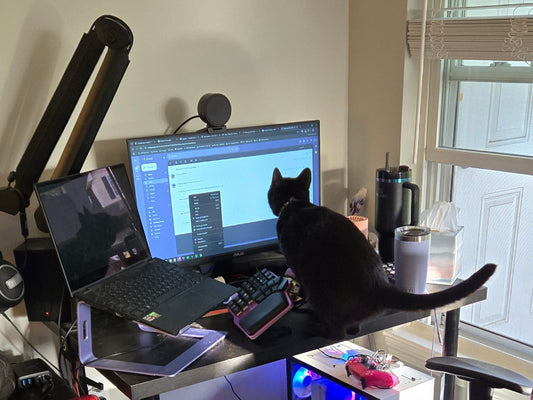
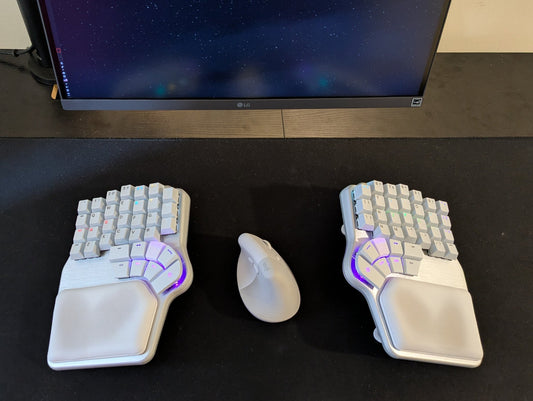
The Dygma Defy and the Dygma Raise 2 are fully split keyboards, meaning you can adjust each side independently.

This lets you align each half with your arms and type in a more comfortable position, so both get two points.
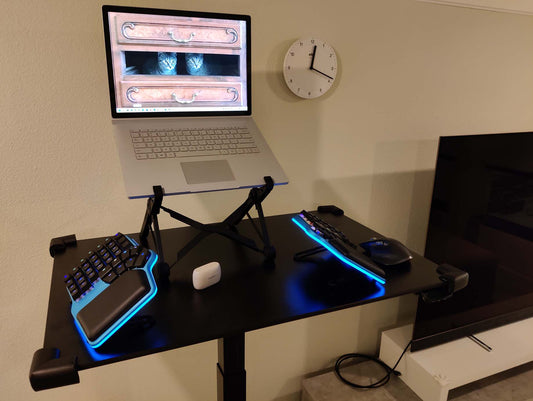
The Dygma Sonsei has a unibody design with a split layout. This gives you a comfortable typing position while allowing maximum portability and practicality.
However, since it's not fully adjustable, the Sonsei gets one point.

Thumbkeys
Thumbkeys play a huge role in comfort and productivity.
Instead of a single space bar, you get multiple keys for things like Enter, Shift, Backspace, or accessing your custom layers.

The Defy is king here, with eight thumbkeys on each side, so it gets two points.
The Raise 2 and Sonsei have four per side, so they each get one point.

Programmability
All three keyboards are fully programmable with Bazecor. You can remap any key and create layers, macros, shortcuts, Superkeys, and much more.
That's one point each.

Tenting
Tenting lets you angle each half so your hands can rest in a more natural position.
The Defy and Raise 2 offer built-in tenting up to 60º, so they each get one point.

Columnar layout
Standard keyboards arrange their keys in staggered rows, a design inherited from typewriters.
But our fingers naturally move forward and backward, not diagonally, which is why the Defy and Sonsei use a columnar layout.

They each get one point.
The Raise 2 has a standard staggered layout, which makes it easier to transition to, but we'll get to that later.

Palm rests and palm pads
Palm rests and pads help support your hands and keep your wrists from bending upwards.
The Defy and Raise 2 have integrated palm rests and magnetic palm pads, so they each get one point.

The Sonsei supports optional palm pads but doesn't have integrated palm rests, so it gets half a point.

Wireless connectivity
The Dygma Raise 2 and Defy offer Bluetooth and 2.4 GHz low-latency RF as a configuration option.

The Sonsei has integrated Bluetooth, and all of them can also be used via USB.

So, all three get one point.
Portability
They say the best camera is the one that's with you, and the same could be applied to ergonomic keyboards.
The Raise 2 and Defy are great, but big and relatively heavy, so you're less likely to take them with you.
That's why we made the Dygma Sonsei: a compact, light, low-profile keyboard that you'd always take with you.
So it gets two points for portability.

RGBW underglow
The Defy and Raise 2 can also be configured with RGBW underglow: individually customizable LEDs around the perimeter that look great and can also indicate layer changes.
So they get one point each.

We left underglow out of the Sonsei to keep it slim, light, and understated.
All three still have per-key RGB, though, so that's one point each.

Hot-swappability, materials, open-source software, and repairability
Finally, all three keyboards are hot-swappable, have anodized aluminum bodies, run open-source firmware and software, and are designed to be easily repairable.
Let's give two points to each keyboard.

Feature comparison score
That leaves us with 13 points for the Defy, 11 for the Raise 2, and 10.5 for the Sonsei.

So, the Defy wins. Thirteen points. Buy that one.
But obviously, that's not how this works.
These points assume that every feature matters equally. And they don't.
Which keyboard is right for your use case?
You might value portability much more than tenting, or tenting much more than wireless.
So the real question isn't which keyboard has the most features.
It's which keyboard has the right features for you.
And there's another key aspect: how easy it is to get used to each keyboard and to switch back and forth between them.
Dygma Raise 2: the easiest transition from a standard keyboard
If you're coming from a standard keyboard or something like the Microsoft Sculpt or Logitech K860, the Dygma Raise 2 is extremely easy to get used to.
It has the same staggered layout, and both halves can be attached, so you can start using it almost like any other keyboard.
Then you can gradually split it apart, reprogram some keys, start using tenting, and make other changes over time.

You don't have to change everything about the way you type on day one.
Plus, since it's the same layout, you can easily switch between the Raise 2 and any run-of-the-mill keyboard.

Dygma Defy and Sonsei: adjusting to a columnar layout

The Defy and the Sonsei have a columnar layout and fewer keys, so they require some adjustment and muscle-memory retraining.
That also makes switching back and forth to a regular keyboard a bit trickier.
It's not that you can't do it, because many people do, but there's a transition period until you build two separate muscle memories: one for each layout.

That's partly why we made the Sonsei, so we'd never have to type on another random keyboard again.
Plus, the Sonsei and Defy share a very similar columnar layout and thumbkey philosophy, so it's super easy to switch between them.

That's actually one of our favorite combinations: the Defy for your main setup and the Sonsei for everywhere else.

So, which Dygma keyboard should you buy?
To sum it up:
Choose the Raise 2 if you want the easiest transition from a traditional keyboard, especially if you'll still use standard keyboards regularly.
Choose the Defy if your priority is getting the most ergonomic features and customization possible for your main workstation.
Choose the Sonsei if you want an ergonomic keyboard you can realistically use everywhere: at home, in the office, while commuting, in meetings, and while traveling.
There's no overall winner here.
There's just the one that fits the way you work.
Which one would you choose?
We hope this comparison helped you decide between our three keyboards.
Join the discussion on Reddit or Discord and share your thoughts.
See you there 💜