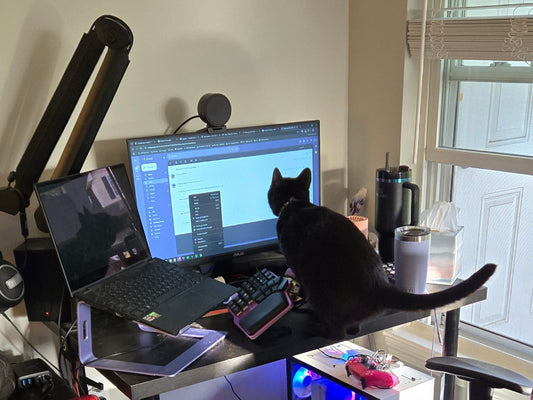
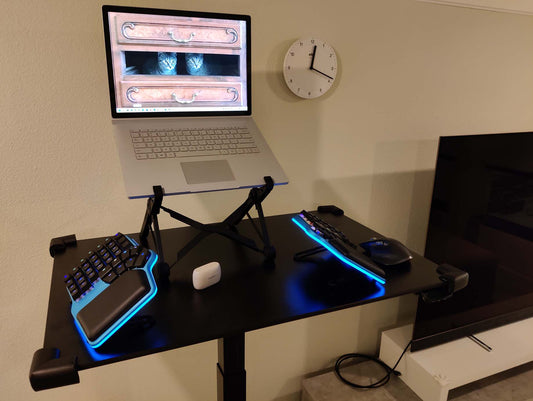
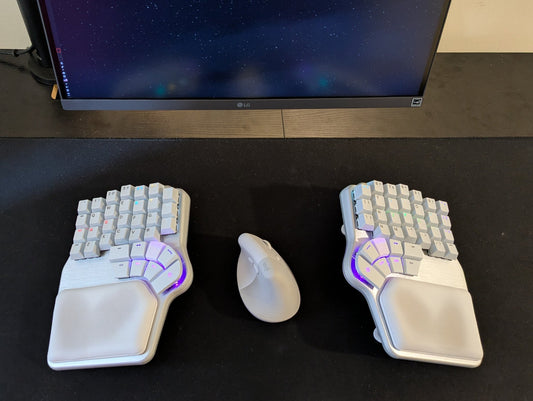
For over a decade, we’ve been saying the same thing: if you want a truly ergonomic keyboard, it has to be split.
Then we made the Dygma Sonsei: An ergonomic keyboard that isn’t fully split.
So, were we wrong all along? Not exactly.
The Sonsei exists because the way we work has changed, and sometimes the most ergonomic solution on a perfect desk isn’t the best solution everywhere else.
This story began years ago, when Luis started traveling frequently for work. Suddenly, work wasn’t happening only at home or at the office anymore. It was happening in hotels, coworking spaces, coffee shops, trains, airports, planes,...
The problem is that none of those places are really designed to be comfortable workspaces.

At your own desk, you can control almost everything: your chair, monitor, keyboard, mouse, and posture.
But as soon as you leave that setup,most of that control disappears. And more often than not, you end up working directly from a laptop.

The hidden cost of constantly changing setups
Working in different environments isn’t just less comfortable.
Every time you move, your body and your brain need to adapt to a new chair, screen, keyboard, and working position.
And if you’re used to an ergonomic keyboard, you also lose something else: your workflow.

Your columnar layout, thumbkeys, layers, macros, and shortcuts are no longer there.
Everything you’ve spent years configuring to make your keyboard work around you suddenly disappears.

Then there are what we started calling the lost moments.
Waiting 15 minutes for a meeting to begin. Sitting at an airport gate for two hours. Having 20 minutes before a train arrives. Riding in a taxi.
Individually, those moments don’t seem important. But over the course of a year, they can add up to hundreds of hours.

If starting work requires unpacking a complicated setup every time, those small windows are often simply lost.
Why not just travel with a split keyboard?
That was the obvious first solution. Luis started taking his Dygma keyboards with him.
And in hotels, coworking spaces, and temporary offices, they worked great.

But frequent travel exposed a problem.
A fully split keyboard takes up more space in a bag, requires you to position two separate halves, and can become awkward when your workspace is tiny.
On a proper desk, that flexibility is one of its greatest strengths. On a train tray table or a plane, it can become a disadvantage.

Could we recreate the experience on a laptop?
Before designing a new keyboard, we tried solving the problem with software.
Could we somehow recreate Dygma’s layers, macros, and shortcuts directly on a laptop keyboard? Surprisingly, we managed to recreate some of them.
But there was one major problem: no thumbkeys.

Thumbkeys are central to the way our ergonomic layouts work. They move frequently used keys and modifiers away from the weaker pinky fingers and place them under the thumbs instead.
Without them, the whole system felt incomplete.
We even experimented with some very questionable solutions, like moving the hands one row higher so the thumbs could reach more keys.

Technically, it worked.
Ergonomically… not so much.
The first portable ergonomic keyboard prototype
That led to a new question: What if we simply made our ergonomic keyboard smaller?
We started removing everything that wasn’t absolutely essential: The palm rests could go, and we could remove some of the thumbkeys and inner columns.

Low-profile switches and keycaps would make the keyboard thinner and lighter.
Of course, making all those changes meant designing new electronics, new mechanical parts, and an entirely new enclosure.
Fortunately, making ergonomic keyboards is kind of our thing.
So we built a prototype.

The first compact prototype was a success in many ways: It was smaller, lighter, and easier to transport, and it kept the things we cared about most: A columnar layout, dedicated thumbkeys, layers, macros, and custom shortcuts

It was comfortable enough for use at home or in an office, and much easier to pack for travel.
But strangely, it failed in the exact situation it was designed for: working on the go.
Two separate keyboard halves were still awkward on small café tables, trains, and planes.
They didn’t sit properly on top of a laptop, and balancing both halves on your lap was frustrating.

There was also another problem: friction.
When you only have 20 minutes to work, you don’t want to spend several of them positioning two halves of the keyboard and dealing with extra cables.
You want to pull out your keyboard, start typing, and pack it away just as quickly.
But what if we glued the two halves together?

It sounded almost wrong.
After all, the split design had always been one of the fundamental principles behind our ergonomic keyboards. But in this specific case, the fully split design was also what prevented the keyboard from reaching its full potential.
So we built another prototype, but this time, both sides shared a single unibody case.

We kept the two halves angled inwards to preserve a more natural hand position.
We also made the keyboard small enough to fit comfortably alongside a laptop and easy enough to use directly on your lap.

The result surprised us: The unibody design was dramatically easier to use on planes, trains, and small tables.
You could simply take it out of your bag, place it down, and start typing.

But something even more unexpected happened. It was also comfortable at home and in the office.

Even though the keyboard wasn’t fully split, the two sides were still separated and angled enough to offer a much more natural typing position than a standard keyboard.
And crucially, it kept the features we didn’t want to sacrifice: Split columnar layout, ergonomic thumbkeys, custom layers, macros and shortcuts, and full programmability.

Luis used that prototype for months.
Eventually, he used it so much that the 3D-printed case literally started falling apart.

That was when we knew the idea was worth turning into a real product.
Turning the prototype into the Dygma Sonsei
The final Dygma Sonsei retains the core ideas that made the prototype work, turning them into a keyboard designed for everyday use.

The Sonsei isn’t fully split, but its two sides are clearly separated and angled, while keeping the convenience of a single compact unit.

There are four thumbkeys on each side, giving your thumbs access to frequently used functions, modifiers, and layer controls.

Like our other keyboards, the Sonsei is fully programmable.
You can create your own layers, reassign keys, build macros, and configure your keyboard around your personal workflow.

Portability wouldn’t mean much if you had to deal with cables every time you wanted to work.
The Sonsei can connect wirelessly, so you can take it out, turn it on and start typing.

The Sonsei features a replaceable 2,000 mAh battery.
With the LEDs turned off, it can last for more than 40 days, while full LED brightness still provides more than 8 hours of continuous typing.

The Sonsei is approximately 30 cm wide and just over 18 mm tall with its switches and keycaps installed.
It also weighs under 400 g, making it easy to carry between workspaces.

Despite its low weight, the aluminum body keeps the keyboard rigid and sturdy.
Every Sonsei comes with a Travel Sleeve, making it easier to protect and carry alongside your laptop and other essentials.

Working remotely often means sharing your workspace with other people.
That’s why the Sonsei uses multiple sound-absorbing layers to help keep its sound controlled in offices, meetings, and shared environments.

You can also customize the typing experience by choosing from different low-profile switches and keycap options.
Whether you prefer something smooth, tactile, silent, or clicky, you can configure the Sonsei to better match your preferences.

So, were we wrong about split keyboards?
No.
If you have enough space and complete control over your workspace, a fully split keyboard still gives you more freedom to position each half around your body.
That remains the most flexible ergonomic solution, but ergonomics doesn’t exist in a vacuum. The best keyboard is also one you can actually use in your environment.

When your desk is a café table, an airplane tray, your lap, or a temporary hotel workspace, portability and simplicity become part of the equation. That’s the compromise behind the Sonsei.
It gives up the complete freedom of a fully split keyboard in exchange for something we found increasingly valuable: the ability to take an ergonomic layout almost anywhere.

Was breaking the golden rule worth it? For us, yes.
The Sonsei wasn’t designed to replace every fully split keyboard. It was designed to solve a different problem.
It keeps the columnar layout, thumbkeys, programmability and ergonomic principles we care about, while making them much easier to carry and use in places where a traditional split keyboard simply isn’t practical.

Sometimes breaking a rule doesn’t mean the rule was wrong. It just means the context changed.
What do you think? Was the trade-off worth it, or would you still take a fully split keyboard everywhere you go?

Join the discussion on Reddit or Discord and share your thoughts.
See you there 💜